

The Misconception about Machine Learning
What users fear when starting Machine Learning is the loss of human control when making decisions. This is what needs to be clarified, if Machine Learning only helps decision making through predictions generated by model/machine. Decision making is still done by people.
In this article, we will show examples of using Machine Learning prediction results to make decisions.
The Modeling Goals
An insurance company wants to create a machine learning model that can predict normal and fraudulent claims. The results of the predictions will be used to determine which claims require further examination. Claims that are predicted to be normal will be immediately approved for disbursement of funds, and claims that are predicted to be fraud will be examined.
The insurer has the goals of reducing operational costs while still prioritizing minimal losses, and accelerating the standard level agreement (SLA) when examining claims.
The Model’s Confusion Matrix
The results of the modeling can be seen in this confusion matrix.
| Predicted: Normal | Predicted: Fraudulent | |
| Actual: Normal | 12.217 | 7.247 |
| Actual: Fraudulent | 19 | 512 |
From 19,995 claim data, the model provides predictive results:
- As many as 61,12% of claims are categorized as genuine, the remaining 38,88% are claims that need re-checking
- Of the 531 claims predicted fraud, the model was able to correctly predict 512 claims (96,4% precision)
- Of the 12.236 claims that were actually normal, the model was able to predict 12.217 of them (99,8% recall)
We Try To Do A Calculation
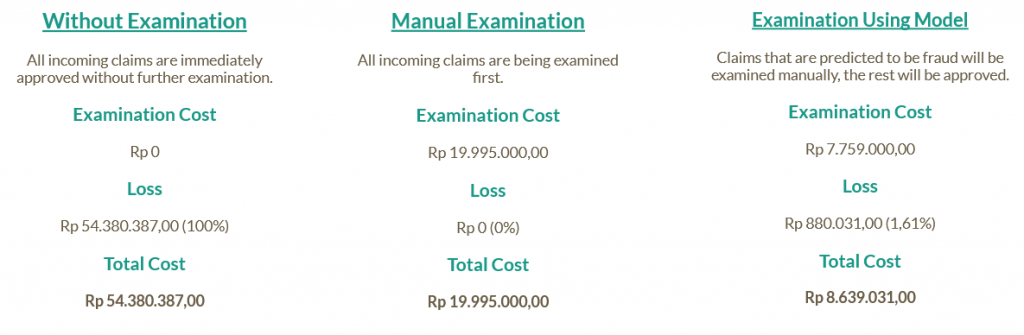
Assuming the operational cost of checking 1 claim is IDR 1000, we can perform this calculation based on the model result.
What We Can Get From the Calculation?
Even though examination using the model result losses, since there are incorrect predictions by the model, the overall cost is still the smallest.
Manual examination will be more profitable if the cost of examine per claim is < IDR 71.
This result is obtained from a model that produces a proportion (approximately) 60% of claims are predicted to be normal and 40% are predicted to be fraud. So in other words, insurance companies still need to examine 40% of claims.
Furthermore, we can build another Machine Learning model that produces a proportion of fraud predictions below 40%, therefore the insurance effort to carry out manual examination is smaller.
We Build A Simulation
We build another 4 models that yielded less percentage of manual examination and simulated their costs.
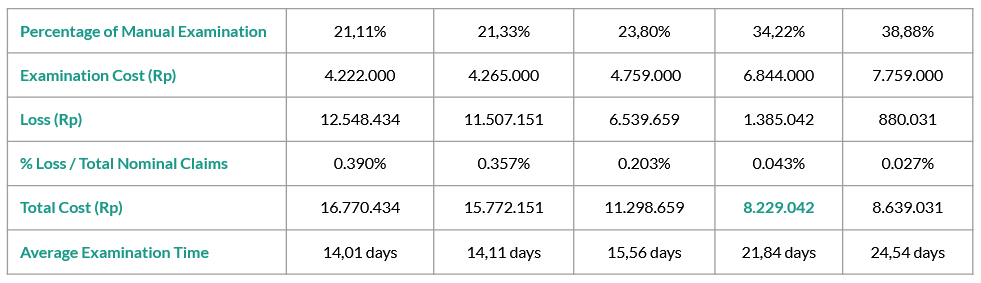
The greater the percentage of claims that are examined manually, the examination cost and average examination time increases, but the risk of loss (on average) is smaller. The optimal total cost when 34.22% of claims are examined manually.
The Simulation Results Can Help Your Decision Making
From this case example, it can be seen that:
- The model does not only have 1 result, but can be adjusted so that it gives a variety of results
- It can also be used to choose the best model, adjusted to the operational cost and risk of loss that you want to take
- The predicted results from Machine Learning models help us to make various simulations. Through this simulation, the best options and decisions can be selected
We can help you build models and perform data analysis according to your business conditions and targets. Let us know what you need.